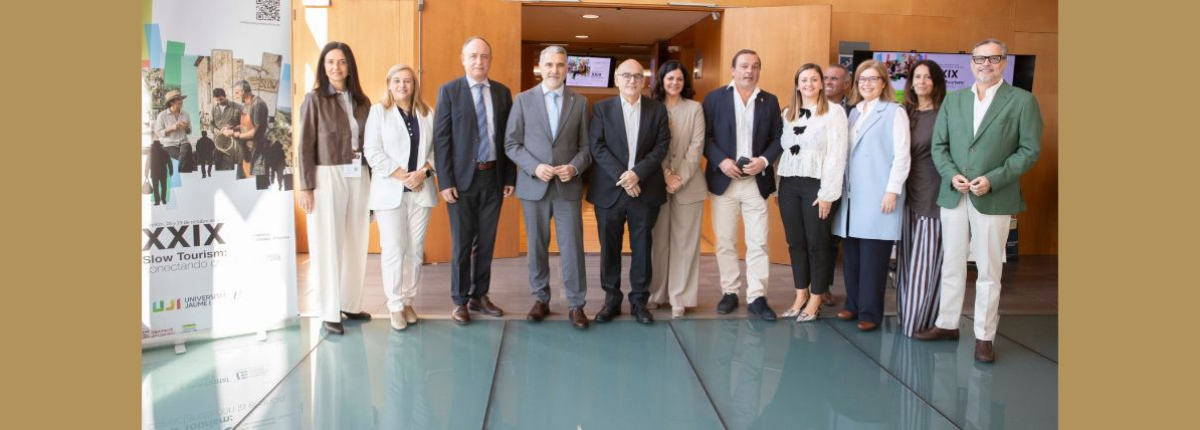
The 29th International University-Business Tourism Conference, held on 28 and 29 October at Universitat Jaume I under the theme “Slow Tourism: Connecting with the Essence”, concluded today with a call to move towards a more sustainable tourism model that respects the identity of destinations and is committed to local communities.
The event, which attracted more than 140 registered participants, brought together researchers, professionals, students and representatives of the tourism sector. Organised by the Universitat Jaume I-Business Foundation (FUE-UJI), sponsored by the Castellón Provincial Council through its Provincial Tourism Board, and supported by Turisme Comunitat Valenciana, the conference has consolidated its position as a leading forum for knowledge exchange between academia and industry.
Among the highlights was a keynote presentation by Isabel Sánchez Tejado, an expert in sustainable rural tourism and regenerative tourism, entitled “Regenerative Tourism: When Visiting a Destination Means Creating Value”. Her presentation explored a new approach to tourism aimed at generating a positive impact on destinations and their communities.
Alberto Ecay, Director of the Sustainable Territorial Tourism Development Service of the Government of Navarre, shared the region's experience in his presentation “Navarre: How We Protect Our Secret”. Meanwhile, M.ª Luisa Vázquez, from the University of Valencia, explored new opportunities for urban tourism in her presentation “Alternative Approaches to Urban Tourism: The European Cultural Route of Historic Pharmacies and Medicinal Gardens”. These three keynote presentations were complemented by three expert panels focusing on Slow Tourism and the opportunities it offers.


During the closing session, Conference Director and UJI Professor Rafael Lapiedra summarised the main conclusions of the two-day event, highlighting that “the future of tourism lies in slowing down, connecting with local identity and placing sustainability at the heart of the entire value chain”.
Lapiedra identified three key strategic priorities for advancing towards this tourism model.
Firstly, he emphasised the need to strengthen public-private collaboration, which is essential for coordinating tourism policies, supporting local entrepreneurs and developing balanced, sustainable destinations.
Secondly, he highlighted the importance of traveller awareness and shared responsibility, stating that “tourists are no longer merely passive spectators, but active participants in preserving the destinations they visit”. In this regard, he stressed the need to encourage responsible consumption that supports local businesses and reduces environmental impact.
Finally, he advocated the development of authentic tourism experiences genuinely committed to sustainability, stating that “we need to go beyond the 'green' label and develop tourism products that showcase local culture, biodiversity, locally sourced gastronomy and social equity”.